Can AI Coding Agents Be Thrown Into the Real World?
Imagine hiring a brilliant junior engineer on their first day and immediately giving them full access to your production infrastructure. No onboarding. No staged permissions. No architectural training. Just access to everything — databases, deployment pipelines, infrastructure automation — and the expectation that they will figure things out along the way.
No serious engineering organization would ever operate this way. And yet, this is increasingly how many organizations are deploying AI coding agents today.
The assumption is seductive: if the agent can generate impressive code, it can safely operate inside complex production environments. But writing code is only a small part of real-world software engineering.
The Gap Between Code and Production
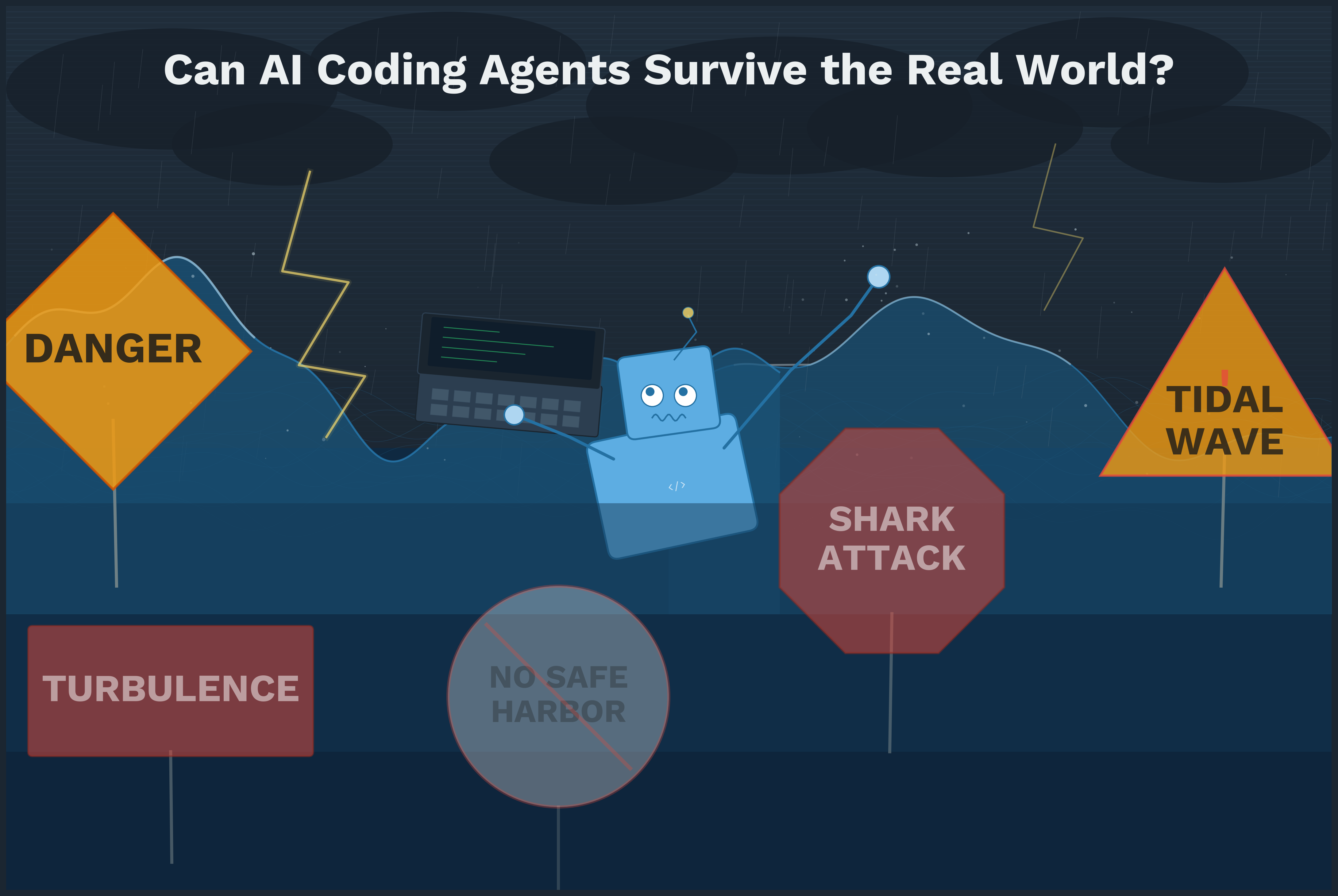
Production systems exist inside messy operational environments filled with hidden dependencies, legacy infrastructure, partial failures, scaling constraints, security controls, and unpredictable edge cases. Small changes that appear perfectly reasonable in isolation can produce cascading consequences when they interact with these systems.
Human engineers learn this through painful experience. They learn to ask what happens if a dependency fails, what happens if a service scales beyond expectations, what happens if the rollback itself breaks, what happens if a change interacts with a legacy component no one remembers. These questions lead to defensive design patterns: guardrails, monitoring, staged rollouts, circuit breakers, and fail-safe mechanisms designed to prevent small mistakes from becoming systemic failures.
AI coding agents are not trained on operational consequences. They are trained on code — repositories, documentation, and examples. They can generate sophisticated implementations, but they do not inherently understand the blast radius of their actions.
This gap becomes dangerous when an agent attempts what appears to be a good-faith improvement. A coding agent may refactor code to improve readability, optimize a query for performance, remove “redundant” checks, or simplify workflows that appear unnecessarily complex. From a code-quality perspective, these actions look reasonable.
But those redundant checks might be the last guardrail preventing a rare but catastrophic failure mode. That awkward retry loop might be protecting against intermittent infrastructure failures. That extra validation step might be compensating for hidden data inconsistencies elsewhere in the system.
Production code contains scars from past incidents. Human engineers recognize those scars because they remember the outages that created them. AI systems do not. They have read the code, but they have never lived through the failures that shaped it.
The result is a mismatch that cuts to the core of the problem: coding agents optimize for elegant code, while production systems optimize for survivable failures.
Strong Architects, Fast Implementers
None of this means coding agents are ineffective. Modern models can generate complex functions, refactor legacy modules, integrate APIs, and produce large volumes of working code at speeds that dramatically accelerate development. At the level of individual modules or services, the code quality produced by leading models can rival that of experienced engineers.
Writing good code in isolation, however, is different from maintaining coherence across an entire software system. Large production environments contain hundreds of services, infrastructure layers, deployment pipelines, and operational dependencies. Maintaining architectural consistency across such systems requires careful planning, disciplined patterns, and long-term design decisions.
In practice, coding agents behave more like extremely productive implementers than reliable system architects. When the architectural design is clear and detailed, the resulting code is excellent. When the system design is incomplete or ambiguous, the generated code drifts toward inconsistent abstractions and incompatible implementation patterns.
The quality of the architecture matters more than ever. Strong designs guide the agent toward good implementations. Weak designs produce weak systems faster.
My Own Experience: Architectural Clarity Is the Bottleneck
My own experience reinforces this pattern.
While building a subscription plan management system for a SaaS application, I worked extensively with Claude Opus 4.6. The model produced high-quality code — but only when the system design was specified in sufficient detail. Even for a relatively contained system like subscription management, architectural assumptions had to be clarified, workflows had to be explicitly defined, and the agent needed intervention when implementation paths diverged from the intended design.
What surprised me was not the quality of the generated code. It was how much architectural clarity the model required before that quality appeared. The coding agent could write the code, but it relied heavily on human direction to ensure the overall system remained coherent.
This is the pattern many engineers are now observing: coding agents accelerate implementation, but they do not replace careful architectural thinking. The bottleneck has shifted. It is no longer how fast you can write code. It is how clearly you can design the system the code lives inside.
Why Human-in-the-Loop Engineering Still Matters
Architecture reviews, code reviews, testing pipelines, staged rollouts, monitoring, and rollback mechanisms exist precisely to protect complex systems from unintended consequences. These practices evolved through decades of operational failures across the industry. AI systems do not automatically inherit that operational wisdom.
Without proper guardrails, even well-intentioned automated changes can introduce systemic risk. Human-in-the-loop workflows remain essential because humans still provide the architectural judgment, operational experience, and risk evaluation required to keep large systems stable.
Coding agents can dramatically accelerate implementation. Trusting them to independently manage the full lifecycle of complex production environments is still premature.
The Real Lesson
The lesson from recent high-profile incidents is not that AI coding agents are dangerous or ineffective. The real lesson is that the engineering discipline required to integrate them safely has not yet caught up with the capabilities of the tools.
Organizations that treat coding agents as autonomous engineers will encounter subtle but severe operational failures. Organizations that treat them as powerful development tools — guided by strong architectural design and human oversight — will unlock enormous productivity gains.
The difference between those two outcomes is not the capability of the AI system. It is the maturity of the engineering process surrounding it.
We started with a junior engineer handed the keys to production on day one. The coding agent is that engineer — brilliant, fast, and eager to ship. The question is not whether the agent can write the code. It can. The question is whether your organization has the architectural discipline, the operational guardrails, and the engineering culture to make that speed safe.
The ocean is not a swimming pool. Production infrastructure does not grade on potential.